
Fuel prices in Sri Lanka have come under renewed pressure after Sinopec announced a significant increase in selected fuel categories, creating a noticeable price gap with state and other private suppliers.
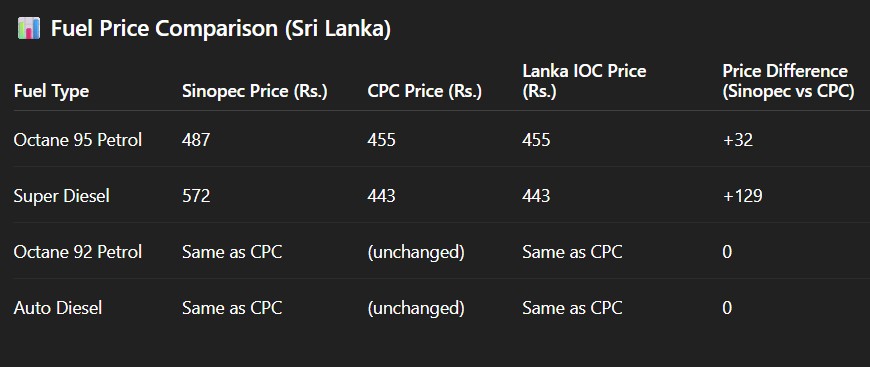
According to the latest revision, Sinopec has raised the price of Octane 95 petrol by Rs. 122 per litre, bringing it to Rs. 487. Super Diesel has seen an even sharper increase of Rs. 219 per litre, now priced at Rs. 572.
Price Gap Widens
The increase has resulted in a substantial disparity compared to prices set by the Ceylon Petroleum Corporation (CPC), which currently sells Octane 95 at Rs. 455 and Super Diesel at Rs. 443.
This creates a price difference of Rs. 32 per litre for Octane 95 and a striking Rs. 129 per litre for Super Diesel between Sinopec and CPC.
Industry observers note that such a gap could influence consumer behavior, with motorists and transport operators likely to shift towards lower-priced alternatives.
Lanka IOC Holds Steady
Meanwhile, Lanka IOC has confirmed that it will maintain its fuel prices in line with CPC rates, reinforcing a pricing consistency between the two suppliers.
This alignment effectively positions CPC and Lanka IOC as more competitive options in the current market environment.
No Change for Other Fuel Types
Sinopec has, however, kept prices unchanged for Octane 92 petrol and Auto Diesel, aligning those categories with CPC pricing.
This selective adjustment suggests a targeted pricing strategy focusing on premium fuel segments.
Market Implications
The latest price revision highlights the evolving dynamics of Sri Lanka’s liberalized fuel market, where multiple suppliers now operate with varying pricing strategies.
Experts suggest that the widening price differences could:
- Increase competition among fuel providers
- Shift demand toward lower-priced suppliers
- Impact transport and logistics costs, particularly for diesel-dependent sectors
Consumers are expected to respond quickly to the price differences, especially in the context of ongoing cost-of-living pressures.
With global oil prices and exchange rate pressures continuing to influence local pricing decisions, further adjustments across suppliers remain possible in the coming weeks.
For now, the spotlight remains on Sinopec’s aggressive pricing move and its potential ripple effects across Sri Lanka’s fuel market.











 English (United States) ·