
Marvel Studios has destroyed cities, collapsed timelines, and erased half the universe. Yet as anticipation builds for Avengers: Doomsday, the internet is converging on a far more unsettling idea: this time, the apocalypse may not be explosive.
It may be generational.
Across social media, fan forums, leaked teaser breakdowns, and entertainment journalism, one theory has begun to dominate conversation. Doctor Doom, Marvel’s most calculating antagonist, is not targeting the Avengers themselves. He is targeting what comes after them.
Their children.
If the theory is correct, Doomsday will not be remembered as a battle for survival, but as a psychological reckoning about legacy, inheritance, and whether heroism survives once its founders step aside.
A Villain Who Thinks Beyond Victory
Doctor Doom has always been different. Thanos believed in balance through destruction. Doom believes in permanence through design.
In Marvel lore, Doom studies futures the way generals study maps. He does not conquer the present; he edits the long game. Fans argue that this is why Doomsday feels tonally different even before release. The threat is not extinction. It is replacement.
If Doom has seen futures where he fails, logic dictates those failures are not caused by today’s Avengers — but by tomorrow’s ones.
Children, in Doom’s worldview, are not innocents.
They are variables.
The Quiet Introduction of the Next Generation
Over the past several MCU phases, Marvel has introduced legacy children almost casually.
Love, Thor’s daughter, resurrected and empowered by Eternity
Franklin Richards, son of Reed Richards and Sue Storm, a reality-shaper in comic canon
Persistent rumors of a Steve Rogers heir, hinted through Endgame’s unresolved timeline choices and leaked teaser descriptions
Individually, these moments felt like emotional epilogues. Together, fans believe they form a structural blueprint.
Power. Reality. Moral legitimacy.
The foundations of a future civilization.
PULL QUOTE
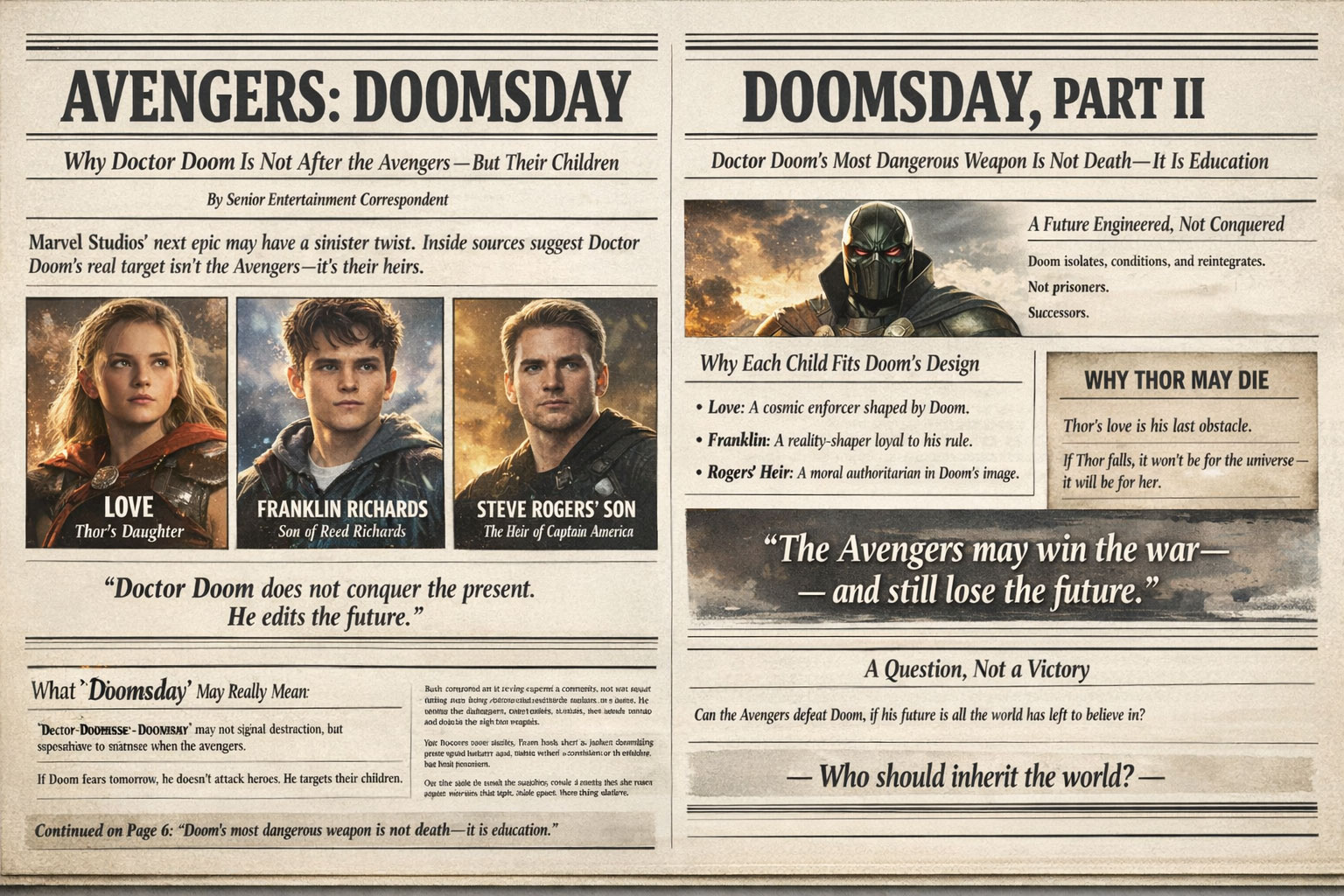
“Doctor Doom does not need to rule forever — only long enough to design who rules next.”
Why the Internet Believes Doom Wants the Children Alive
One of the most viral twists in current fan theory is also the most disturbing: Doom may not intend to kill these children at all.
Instead, fans believe his plan is ideological.
According to this interpretation, Doom isolates the children, removes parental influence, and educates them within a philosophy that frames control as compassion and order as mercy. When they return to the world, they do not conquer it.
They stabilize it.
Not tyrants.
Believers.
This reframes Doomsday from a war film into a moral thriller.
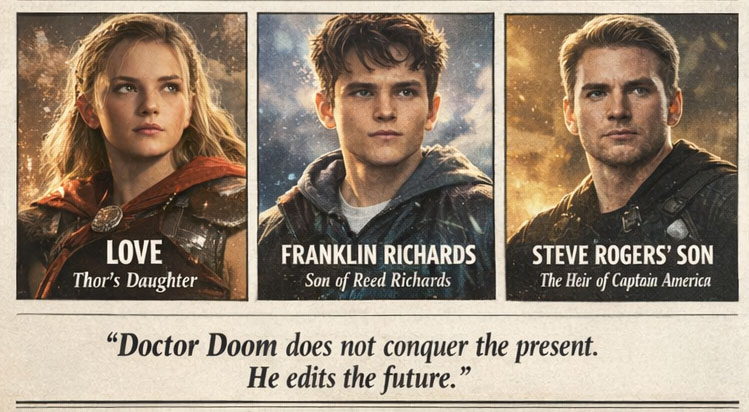
Love, Franklin, and the Shape of Doom’s Future
Each child fits Doom’s vision with terrifying precision.
Love represents unchecked divine power — a god unburdened by tradition or restraint. Without Thor’s influence, Love could become a cosmic enforcer who equates decisiveness with kindness.
Franklin Richards is the most dangerous being in Marvel canon not because he fights, but because he imagines. Raised under Doom’s worldview, Franklin might unconsciously create realities where Doom’s rule is not imposed — it simply exists.
A universe where resistance never forms because no one remembers another way.
A Rogers heir, meanwhile, would be Doom’s most audacious success. Not a dictator, but a moral authoritarian. Captain America’s ethics — sacrifice, duty, responsibility — reframed to argue that freedom itself must be limited to save humanity from chaos.
PULL QUOTE
“The Avengers may win the war — and still lose the future.”
The Avengers’ Most Impossible Choice
If this theory holds, Avengers: Doomsday may reach its emotional climax not with an explosion, but a reunion.
The Avengers find the children alive.
Safe.
Educated.
And loyal — to Doom.
At that moment, heroism fractures. Do the Avengers fight their own children? Do they destroy a future that claims to have ended war, hunger, and instability? Or do they accept that the world may choose Doom’s order over their freedom?
Marvel has never asked its heroes — or its audience — a question this uncomfortable.
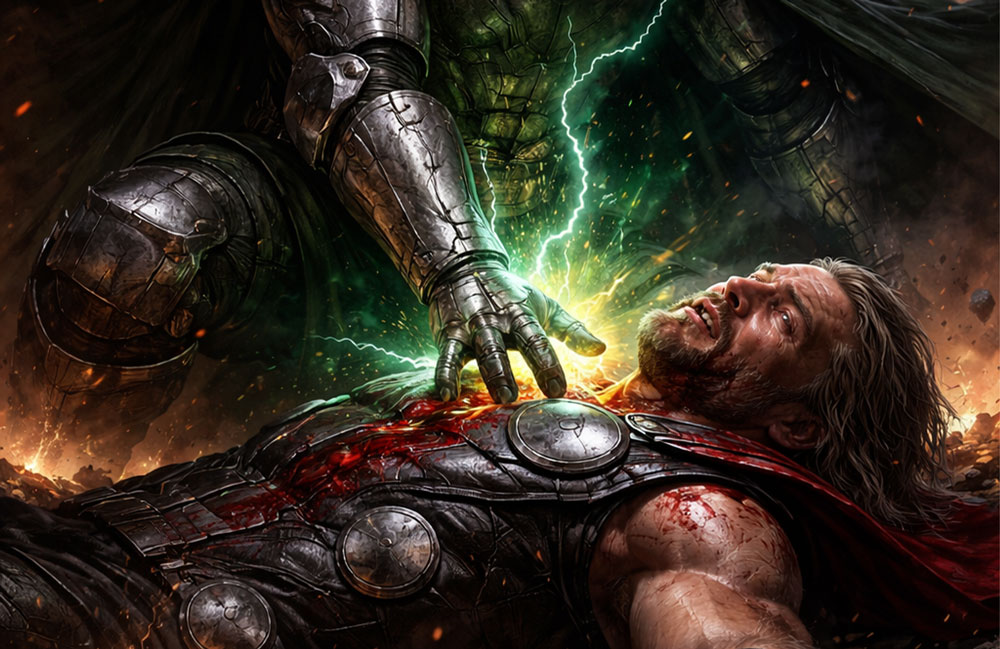
Why Fans Think Thor May Die
One prediction surfaces again and again in online discussions: Thor’s death.
Not as spectacle. As necessity.
Thor represents something Doom cannot replicate — unconditional love without control. Love cannot be reshaped while Thor lives. If Thor falls, fans believe it will not be in defense of the universe, but in defense of a child’s right to choose who she becomes.
It would be a death not of power, but of principle.
Doomsday as a Turning Point
Even if Doctor Doom is defeated, many fans believe the damage will remain. The world will have seen an alternative future — one built on stability rather than freedom.
Some will prefer it.
And the Avengers will be left with a realization more devastating than any loss they have suffered before: saving humanity once does not guarantee it remains heroic forever.
The Question That Defines the Film
Across all viral theories, one question keeps resurfacing:
Avengers: Doomsday may not ask whether the Avengers can win.
It may ask whether they should —
if the future no longer wants them.
If Marvel follows through on even part of this speculation, Doomsday will mark a tonal shift for the MCU — away from clear victories and toward generational consequence.
And that may be the boldest move the franchise has ever made.
Why These Children Exist at All
Legacy Is Not an Accident in the MCU
One of the most persistent questions driving online theory is deceptively simple: why introduce these children now?
Marvel has never been casual with narrative inheritance. When legacy figures appear, they do so to solve structural problems in the story world. According to viral analysis, the children in Avengers: Doomsday are not emotional embellishments — they are load-bearing narrative devices.
Each child answers a specific future requirement:
Love exists because the MCU is moving beyond gods toward post-divine cosmology
Franklin Richards exists because the multiverse needs a being who can rewrite, not merely travel between, realities
A Rogers heir exists because symbols outlive soldiers — and Captain America is Marvel’s most durable symbol
Fans argue that Doom does not create this next generation. He recognizes it. And once recognized, it must be controlled.
These children are not “the future” in a generic sense. They are pressure points in the MCU’s long-term architecture.
“The children are not side characters.
They are structural necessities.”
Time Travel, Multiversal Order, and Doom’s Obsession
Why Doom Enters the Story Now
Another viral theory gaining traction links Doom’s motives directly to time travel — not as a gimmick, but as a cosmic violation.
Fans point to Endgame as the original sin.
Steve Rogers’ decision to remain in the past, form a life, and potentially create a child represents something Doom cannot tolerate: an uncontrolled divergence that stabilizes instead of collapsing.
In Doom’s worldview, timelines must either obey order or self-destruct. A stable anomaly — especially one rooted in moral legacy — is unacceptable.
Franklin Richards compounds the threat. He does not travel the multiverse. He generates outcomes. Doom’s fear is not that Franklin will oppose him — but that Franklin will imagine a universe where Doom never mattered.
Love, meanwhile, sits outside time entirely, empowered by Eternity itself. She represents continuity beyond chronology — a living contradiction to Doom’s belief that order must be imposed.
Together, these children form a triad that disrupts Doom’s vision of multiversal hierarchy:
Time disobeys (Rogers legacy)
Reality rewrites itself (Franklin)
Cosmic authority decentralizes (Love)
For Doom, Doomsday is not about conquest.
It is about repairing a broken multiversal order — by removing free variables before they mature.
“Doom does not fear time travel.
He fears time settling without his permission.”
Why This Changes the Meaning of “Doomsday”
With these additions, fans now interpret Doomsday less as an event and more as a deadline.
A final moment before:
Children choose their own ideologies
Timelines normalize beyond Doom’s reach
The multiverse stops requiring a central authority
In this reading, Doom’s urgency makes sense. He is not reacting to heroes.
He is racing against inevitability.
The Quiet Horror at the Heart of the Film
When viewed through this lens, Avengers: Doomsday becomes Marvel’s most philosophical film yet.
Not about saving the world —
but about deciding who gets to define order.
The Avengers fight because they believe freedom must be protected, even if it is chaotic.
Doom acts because he believes chaos is the real cruelty.
And between them stand children who must eventually choose which belief becomes reality.









 English (United States) ·