
UAE Crypto Business Setup: “Crypto-Friendly” Doesn’t Mean “Crypto-Easy”
DUBAI — The United Arab Emirates has spent the last several years building an international reputation as a serious jurisdiction for virtual assets, with regulators openly courting innovation while tightening the guardrails around consumer protection, market integrity, and financial crime risk.
Recent government-led initiatives have reinforced that message. Dubai’s Land Department (DLD) has launched a pilot phase of a real-estate tokenisation project designed to enable fractional ownership via blockchain, in collaboration with key public-sector partners and within a controlled sandbox structure.
But the same headlines that attract founders and international operators also create a predictable misunderstanding: if a jurisdiction is “friendly,” entrepreneurs assume it is “fast,” “cheap,” and lightly supervised. The reality is the opposite. The UAE’s model is intentionally multi-layered, and the licensing process is designed to filter out under-capitalized or under-governed operators.
What follows is a practical, newspaper-style guide to how the UAE framework works in real terms—and what it means for anyone planning to set up a crypto business here.
The Core Reality: One Country, Multiple Frameworks
The UAE is a federal state, and crypto regulation is split across emirate-level and federal-level authorities. In practice, there is no single “UAE crypto license.” Your regulatory pathway depends first on where you incorporate and what regulated activity you intend to perform.
At the Dubai level (outside DIFC), the market is shaped by Dubai Law No. 4 of 2022, which established the Virtual Assets Regulatory Authority (VARA) and the emirate’s virtual assets framework.
At the federal level, the UAE has also formalized a national layer of virtual asset regulation through Cabinet Resolution No. 111 of 2022, which sets out a broader regulatory framework for virtual assets.
The end result is not duplication for its own sake—it is a deliberate architecture: emirate-based market supervision plus federal safeguards where activities overlap with securities, commodities, and payment systems.
The “Three-Tier” Roadmap (How Licensing Typically Works)
Tier 1 — The Commercial Presence (Incorporation + Business License)
You begin by establishing your legal entity and commercial license—either:
Mainland, through the relevant emirate economic authority; or
Free zone, through a free zone authority.
This step gets you a company. It does not automatically authorize you to conduct regulated virtual asset activity.
Tier 2 — The Crypto/Financial Services Regulator (Activity Authorization)
Once your activity is classified as a regulated virtual asset service, you must obtain approval from the relevant regulator, depending on jurisdiction:
Dubai (outside DIFC): VARA
Dubai International Financial Centre (DIFC): Dubai Financial Services Authority (DFSA) under the DIFC’s separate framework for “crypto tokens.”
Abu Dhabi Global Market (ADGM): Financial Services Regulatory Authority (FSRA), which has maintained a detailed virtual asset regulatory framework for several years.
Ras Al Khaimah: RAK Digital Assets Oasis (RAK DAO), established under Law No. (2) of 2023 and positioned as a dedicated zone for digital and virtual asset firms.
Tier 3 — Federal Approvals (When You Touch Securities or Payments)
Depending on the activity, you may also trigger federal regulators:
Securities and Commodities Authority (SCA) where activities resemble securities/market infrastructure functions under the federal virtual asset framework.
Central Bank of the UAE (CBUAE) where activities overlap with payment systems, stored-value, payment tokens, remittance-like rails, or retail payment services regulation.
This is why “we’ll just be the middleman” often fails as a strategy: the legal definitions are functional. If you facilitate transactions, custody assets, run an order book, issue tokens, or enable wallet-based payment flows, regulators will typically treat that as regulated activity.
Dubai’s Most Common Choice: VARA Outside DIFC
Dubai’s VARA regime is widely discussed because it targets the mainstream Dubai economy and has been central to several public-sector initiatives, including tokenisation projects in the real economy.
DLD’s Real Estate Tokenisation Project—officially launched as a limited pilot—explicitly involves select participants approved in coordination with VARA, underscoring how tightly controlled real-world tokenisation remains at this stage.
VARA also publishes rulebooks and fee schedules that illustrate the government’s policy stance: virtual asset activity is welcome, but it is treated as a high-compliance sector, not a casual startup category.
The Compliance Engine: What Regulators Actually Test
Most serious applicants discover that the real work is not company formation—it is proving to a regulator that you are safe to operate.
Across VARA, DFSA, and ADGM FSRA regimes, the recurring expectations usually include:
1) A Regulatory Business Plan That Is Suggestive of Reality
Regulators expect a coherent description of:
business model and revenue sources,
governance and decision rights,
risk controls, custody model (if any), and conflict management,
technology stack and security posture.
VARA’s rulebooks and associated requirements make clear that authorization is not a formality—it is a fitness test of the operating model.
2) Fit-and-Proper Standards (People Behind the Company)
Founders and senior managers are typically assessed for:
competence and relevant experience,
integrity and reputation,
capability to run regulated operations.
This is a major point of friction for teams that are technically strong but underprepared for regulated governance.
3) AML/CTF Controls Built for Scrutiny
The UAE’s posture reflects global expectations: crypto is inherently higher-risk for financial crime exposure. Expect demands around:
AML program design,
customer due diligence and sanctions screening,
transaction monitoring logic and escalation pathways,
appointment of appropriately experienced compliance leadership.
This is especially material if your product touches fiat rails, wallets, custody, or exchange functions.
The Money Question: Why “Cheap and Fast” Usually Isn’t an Option
In the VARA framework, for example, publicly available schedules show meaningful application and supervisory fees by activity category—reinforcing that this is a capitalized, supervisory market, not a low-cost licensing environment. (Scribd)
Capital requirements are also explicitly structured to scale with risk and operational footprint—particularly for activities like custody, broker-dealer services, or exchange-type functions. (CryptoRank)
Separately, where activities overlap with regulated payments and stored value, the Central Bank’s regulatory regimes for retail payment services and stored value facilities can add banking-grade expectations around security, resilience, and consumer protection. (Crowe)
The practical implication is straightforward: even a “minimal viable” licensed structure must usually be supported by real governance, real controls, and real capital.
The Definition Trap: “We’re Not Custody / Not a Broker / Not an Exchange”
One of the most common failure patterns is definitional avoidance: entrepreneurs describe the same function in softer language, hoping it will fall outside regulation.
But regulators and rulebooks generally classify activities by what you do, not what you call it. The typical regulated categories include advisory, broker-dealer activity, custody, exchange functions, lending/borrowing, management, and transfer/settlement-like functions, each with specific obligations and supervisory expectations.
The strategic takeaway: your legal classification should be done early, and it should be done honestly. Misclassification tends to surface later—often during banking, audits, counterparties’ due diligence, or regulator engagement—and it is expensive to unwind.
Due Diligence for Customers and Partners: Use the Public Registers
The UAE system increasingly pushes transparency. A practical consumer and counterparty safeguard is to verify whether a provider is authorized through the relevant regulator’s public register and official notices.
For example, VARA has issued public marketplace alerts, including warnings about misrepresentation related to Dubai’s tokenisation initiatives. (Vara)
This is a signal of enforcement posture: regulators are not only licensing; they are actively policing market narratives.
Why the UAE Built It This Way
The UAE’s policy choice is clear: attract global operators, but under standards compatible with international finance. The justification is not mysterious:
crypto markets can carry elevated risk of fraud and manipulation,
token issuance and exchange functions resemble securities-market behaviors,
wallets and stable-value instruments can resemble payment systems,
and AML/CTF exposure is structurally higher in virtual asset ecosystems.
This is precisely why federal virtual asset frameworks (Cabinet Resolution No. 111 of 2022) and central bank payment regimes matter in parallel to emirate regulators.
Practical “Services” Needed to Do It Properly (What Serious Applicants Budget For)
If you are planning to operate compliantly, the setup budget is usually dominated less by incorporation and more by the professional build-out. Typical service lines include:
Regulatory Legal Structuring
activity classification, jurisdiction choice (VARA vs DIFC vs ADGM vs RAK DAO),
licensing strategy and regulator engagement mapping.
Compliance Architecture
AML/CTF framework and manuals,
KYC/KYB procedures, sanctions screening workflows,
risk assessments, reporting structures, staff training design.
Technology & Security Readiness
information security policies,
penetration testing and vulnerability management,
key management/custody controls (where relevant),
incident response and business continuity planning.
Governance & Staffing
board/committee structures,
hiring for MLRO/compliance leadership,
HR documentation aligned to regulated operational duties.
Audit, Accounting, and Financial Projections
audited financials (where required),
multi-year projections that match the operating reality,
capital adequacy and overhead analysis.
Banking and Fiat Rails Strategy
bankability assessment and documentation pack,
alignment with CBUAE frameworks where payment functions are triggered.
Bottom Line
The UAE is one of the most institutionally serious jurisdictions for virtual assets in the region, and the direction of travel is unmistakable: tokenisation pilots, regulated market infrastructure, and controlled integration with parts of the real economy.
But the jurisdiction’s “crypto-friendly” posture is conditional. The system is designed to reward operators who can demonstrate governance maturity, credible controls, and adequate capital—and to frustrate everyone else.
If your business model resembles advisory, brokerage, custody, exchange, issuance, wallet/payment functionality, or pooled investment operations, assume the UAE will treat you as a regulated operator and plan accordingly—jurisdiction, approvals, timelines, and budget.
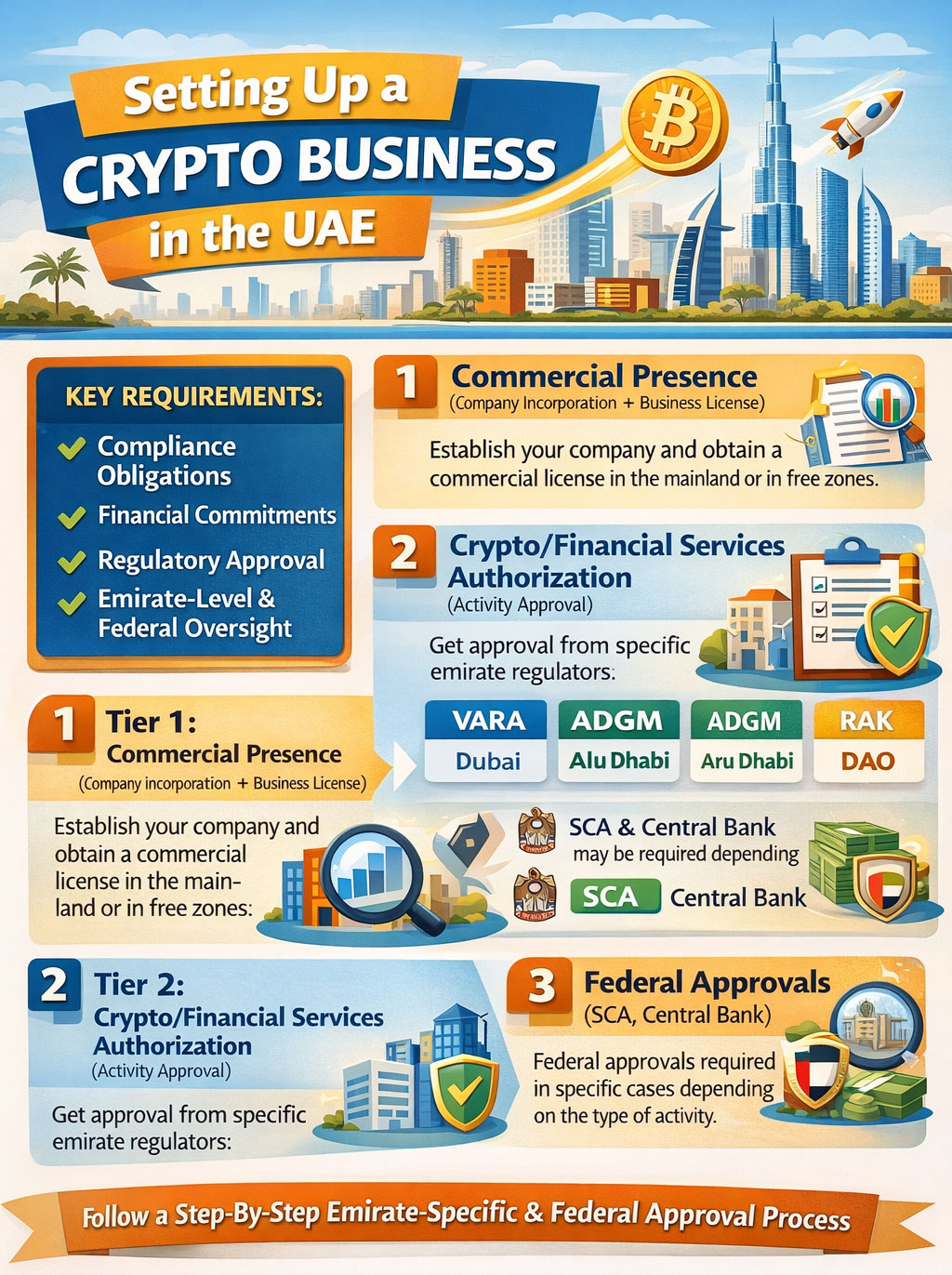 AI-generated infographic. Some visual elements may differ from real-world settings.















 English (United States) ·