Berkeley Commons rises along Aquatic Park. File photo: Ximena Natera, Berkeleyside/CatchLight Local
For decades, drivers on Interstate 880 near Aquatic Park could look east and see mounds of dirt clustered on an undeveloped parcel.
Today, two gleaming, state-of-the-art lab buildings have replaced the piles that once marked the home of American Soil and Stone. They make up the newly completed Berkeley Commons, a 540,000-square-foot complex spanning two city blocks, the largest life science research and development project constructed in Berkeley in a decade. Built by LB2 of Tiburon and Lane Partners of Menlo Park on land leased from the Jones family, the 8.6-acre campus offers modern labs, large floor plates suitable for big pharmaceutical companies, a shared outdoor area, new paths and plantings along Aquatic Park, and even a ceremonial space and garden where Indigenous people can gather.
Yet the buildings are empty.
Berkeley Commons has come onto the market at a time when demand for life science space is low. Supply in Berkeley and the Bay Area — even around the U.S. — far exceeds demand, meaning Class A properties sit unleased longer than their owners want. JLL, the real estate firm handling Berkeley Commons, is actively marketing the property, but no company has firmed up a deal, according to Berkeley city staff and real estate professionals.
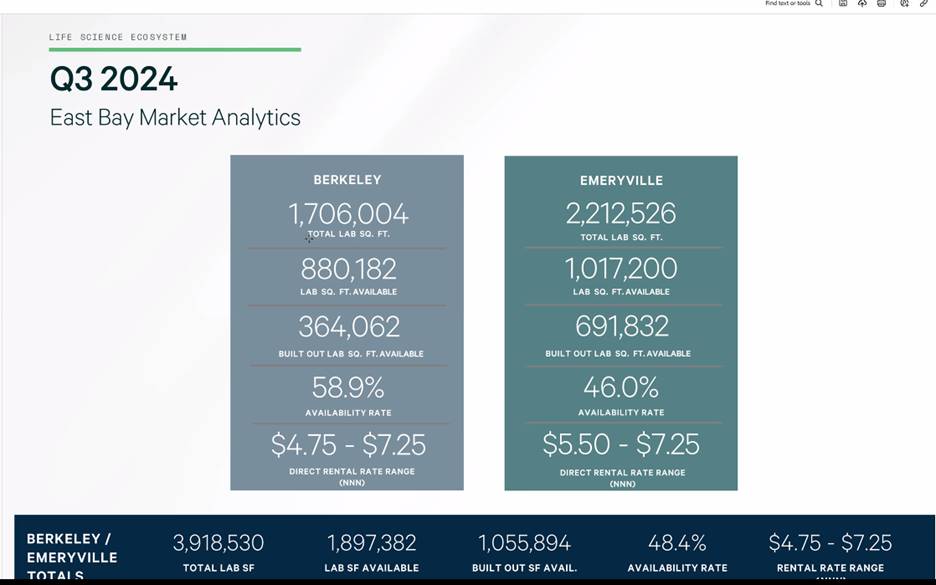
A drive through West Berkeley shows that vacancies are not limited to Berkeley Commons. TheLab Berkeley, a $241 million life science campus with two buildings along Fifth Street, has “lab space available” signs hanging on the buildings’ exterior. Parker Hub at 918 Parker St. is also looking for tenants. And Wareham Development, the company most responsible for transforming West Berkeley into a hub for life science, has vacancies at its Aquatic Park Research Campus, which spreads across 16 buildings. In total, about 58.9% of the lab space in Berkeley is available, according to a third-quarter report from CBRE.
Developers who won the right to build massive life science labs have paused construction.
Steelwave, the group behind TheLab, is waiting until Berkeley Commons has leased out much of its space before breaking ground on a planned third, 250,000-square-foot building on Fifth Street at Bancroft Way, according to Mark Rhoades, whose Rhoades Planning Group advised Lane Partners. The lot is currently an empty field. Redco, which got a 225,000-square-foot building approved at 700 Grayson St., is also waiting for capital to free up, he said.
It’s a turnaround from just a few years ago. During the pandemic, when interest rates were low, and concerns about health high, money from venture capital firms poured into life science endeavors, from fledgling start-ups working in incubator spaces to companies close to a viable product. Developers jumped into the fray to build millions of square feet of lab space to meet perceived demand.
While most of the construction happened in South San Francisco and the Peninsula, the epicenter of the life science ecosystem, there also was a rush to build or convert buildings in the East Bay, including Berkeley and Emeryville. The proximity to Lawrence Berkeley National Lab and UC Berkeley — which has emphasized innovation by creating a number of incubator spaces, including the Bakar BioEnginuity Lab, and teaming up with venture capital firms in recent years — has made the area a center for the creation of new life science companies.
In 2023, Pitchbook ranked UC Berkeley No. 1 for having the most venture-funded start-ups founded by undergraduate alumni. Berkeley-connected founders had started 1,305 startups; Stanford start-ups, 1,297, Pitchbook calculated.
According to the city’s economic dashboard, the city of Berkeley had 400 innovation companies in 2023, of which 81% were startups. About 35% of those start-ups, and the largest sector, were in healthcare and life sciences.
One example of the university-to-company pipeline is Caribou Biosciences, which Professor Jennifer Doudna and her then-graduate student Rachel Haurwitz launched in 2011 using CRISPR technology. (Doudna later won a Nobel Prize for her research). QB3, which the University of California set up to support early-stage commercialization in biotech and pharmaceutical companies, provided initial funding. Caribou Biosciences is now a publicly traded company with offices on Seventh Street in Berkeley.
Other successful Berkeley life science companies include Carmot Therapeutics at 740 Heinz St in the Aquatic Park, which makes drugs to combat obesity. Roche, the giant pharmaceutical company, recently acquired it for $2.7 billion. Kimia Therapeutics, a Carmot spinoff that is working on oncology drugs, raised $55 million in December. And the federal government just invested $226 million into Hopo Therapeutics, located in Bakar Labs in the Bakar Bioengineity Hub at UC Berkeley. It makes an oral drug that shows promise in stripping heavy metals like plutonium from the body — which could be applied if a nuclear weapon is detonated.
Berkeley’s life sciences vacancy rate higher than on the peninsula
But venture capital firms in general have pulled back in recent years, prompting retrenchment. Companies are conserving their money, shedding jobs and real estate, and even subleasing some of their own spaces. The upshot: Building supply in Berkeley and elsewhere exceeds demand. According to a report by the Newmark Group, the vacancy rate for life science space in Berkeley was 43.2% in the third quarter of 2024. In contrast, the vacancy rate on the San Francisco peninsula sat at 34.0%, according to a report from CBRE.
“We’re off of the high that fueled the supply side of the market,” said one real estate executive in the life sciences whose company would not allow him to speak on the record. “In 2020-21, there was an insane amount of demand from tenants anticipating light-speed growth, but that growth didn’t always end up happening. Some companies leased too much space and are now trying to give it back, while others have hunkered down and decided to make it work in their current space.”
“Construction projects take years,” he said. “There was a mismatch of when the product was available and the demand.”
It is ironic that Berkeley has ample space for life science businesses and other R&D projects. For decades, Berkeley was known as the city that could incubate businesses, which then had to leave for other cities because the 1993 West Berkeley Plan limited R&D and office space. Berkeley saw Clif Bar and Power Bar depart when they outgrew their Berkeley locations.
In recent years, the Berkeley City Council has loosened zoning regulations to retain Berkeley-born companies and encourage R&D uses in West Berkeley, downtown, and along Telegraph and Shattuck avenues. Last week, it expanded tax breaks for research and development startups to grow the city’s innovation sector.
It’s a recognition that life science businesses employ blue-collar workers, a demographic the original West Berkeley Plan was set up to conserve, said Rhoades.
“If we want to keep blue-collar businesses in West Berkeley, we need to think about what those land uses are in a more modern perspective,” he said. “They employ a broader range of people … than the tech world.”
One unintended benefit of Berkeley’s reluctance to rezone how industrial buildings in West Berkeley could be used was that the city protected itself from “the Google invasion of the 2000s,” said Rhoades.
Life sciences sector expects better days ahead
Despite the soft leasing market, the developer behind Berkeley Commons, real estate agents, and people in the life science sector think Berkeley and the San Francisco region will roar back.
They point to a small uptick in leasing around the Bay Area. Seed money for start-ups is tight, but venture capital firms are investing in companies that have reached major milestones, which means they are closer to a viable product, according to Kaspar Mossman, a managing director at QB3, UC’s hub for life science entrepreneurship.
“Access to capital has improved steadily throughout 2024, and this trend should continue into the new year as companies further drive innovation,” reads part of the CBRE report. “The sector’s inevitable expansion will be met by an abundance of premier lab space, which has seen exponential growth in recent years.”
The developers behind Berkeley Commons released a statement indicating their faith in the building and the market.
“Berkeley Commons is the premier life science campus on the market,” wrote Nick Menchel, a principal at Lane Partners. “We believe it will help elevate the profile of the existing West Berkeley life science hub and fuel further growth in the area.”
Elizabeth Redman Cleveland, Berkeley’s chief strategist of sustainable growth at Berkeley’s Office of Economic Development, isn’t overly worried by the current vacancy rates. The pendulum will swing back again, she said.
“There is a lot of innovation that will be happening in Berkeley for many years to come,” she said. “No one is questioning that. We don’t have any major long-term concerns. It’s an issue of timing.”
 An aerial view of the R&D space planned for 600 Bancroft Way. Courtesy: HGA
In fact, in a sign of belief in the long-term market, another developer recently submitted plans to convert an office space in West Berkeley into an R&D space. Woodstock Development unveiled plans to tear down three buildings along Aquatic Park and construct two life science buildings across the street from Berkeley Commons at 600 Bancroft Way. One building would be three stories, and the other would be four, creating 247,250 square feet of lab space. Woodstock also intends to construct a garage with 512 spaces.
“We are very excited to begin planning this state-of-the-art life sciences hub in this growing cluster in West Berkeley,” said Woodstock Development President Kirk Syme.
In the meantime, brokers for Berkeley Commons are actively marketing the space.
Benjamin Stolurow, a graphic novelist who has an office in his family’s Fifth Street office building across from LabBerkeley, said all the vacancies mean the area feels deserted. He had hoped that the new development would bring more workers to the area and that small restaurants and cafes would pop up to feed them. That hasn’t happened yet.
While Berkeley Commons awaits tenants, Berkeley residents can take advantage of the $5 million in amenities the developers built as part of its community benefits package. They vastly improved the accessibility of Aquatic Park, which the city is aiming to revive. They built a new 14-foot-wide bike and pedestrian path on the west side of Bolivar Drive, next to the water, planted a large, publicly accessible native plant garden, added three lawn areas, picnic tables and grills, pathways and benches, an outdoor classroom area, and parking areas, and created an Ohlone medicinal planting garden and ceremonial platform, among other amenities.
Ryan Moran, who has walked along Bolivar Drive for years, expressed tentative appreciation for the new improvements on Tuesday afternoon. He liked them but was also wistful about the end of the funky Bolivar Drive.
“There was something charming about the rundown, busted roadway in front of BORP,” he said. “It was quiet. Now its very nice and dressed up. But this is a nice addition to the peaceful scene that has always drawn me here.”
“It’s a beautiful building,” said James Bennett, the vice-chairman of life science practice at CBRE. “It has all the infrastructure for lab-type users. It’s well-conceived and well-built for industry.”
"*" indicates required fields
Send a private note to the editors.*
See an error that needs correcting? Have a tip, question or suggestion? Drop us a line.














 English (United States) ·