
Low-Cost 3D-Nanoplasmonic Assay Chip for Ultra-Sensitive Cancer Gene Detection
Early and accurate detection of cancer-related genetic mutations is critical for improving patient outcomes, especially in lung cancer, where mutations in the epidermal growth factor receptor (EGFR) gene are prevalent. However, current diagnostic methods such as next-generation sequencing (NGS) and real-time polymerase chain reaction (PCR) face significant drawbacks, including low sensitivity, high costs, and extended processing times. A recent breakthrough in nanotechnology introduces a highly sensitive and cost-effective 3D-nanoplasmonic-based multiplex assay chip, offering a transformative approach to detecting EGFR mutations with unprecedented precision and speed.
Challenges in Current Cancer Mutation Detection
EGFR mutations are critical biomarkers in lung cancer, accounting for over 50% of cases. The most common mutations—exon 19 deletions, exon 21 L858R point mutations, and exon 20 insertions—are traditionally detected using methods like NGS. Although these technologies have advanced cancer genomics, they struggle with low mutation frequency sensitivity (≈1%) and require specialized equipment, making them impractical for widespread screening. Moreover, the lengthy turnaround time and high costs associated with NGS limit its utility in early cancer diagnosis and monitoring.
Introducing the 3D-Nanoplasmonic-Based Multiplex Assay Chip
This novel assay chip leverages advanced nanotechnology to overcome the limitations of traditional methods. The chip features a 3D-nanoplasmonic substrate—comprised of densely packed gold (Au) nanopillars decorated with Au nanoparticles—which dramatically enhances fluorescence signals, allowing for the ultra-sensitive detection of EGFR mutations. The assay chip can detect mutations at a frequency as low as 1 × 10⁻⁹%, corresponding to just three copies per reaction, setting a new benchmark for analytical sensitivity in cancer diagnostics.
Key Features and Mechanism
3D Nanoplasmonic Substrate: The heart of the assay is its 3D nanoplasmonic substrate, which significantly amplifies fluorescence through plasmon-enhanced fluorescence (PEF). This effect boosts the electromagnetic field interactions at the nanoscale, enabling the detection of extremely low levels of mutated DNA even when wild-type DNA is predominant.
Multiplex Detection Capability: The chip is equipped with a multiplex detection system that allows simultaneous identification of multiple EGFR mutations, including exon 19 deletions, exon 21 L858R point mutations, and exon 20 insertions. This capability is crucial for comprehensive genetic profiling in a single assay.
Wild-Type Inhibitors: The assay employs specific wild-type inhibitors that suppress the amplification of non-mutated (wild-type) DNA. These inhibitors are crucial for enhancing the detection sensitivity of mutant DNA, as they prevent background noise from wild-type sequences.
Rapid and Cost-Effective Process: The entire assay operates at a low reaction temperature of around 37 °C and requires just 70 minutes of processing time after DNA extraction. This rapid turnaround makes it feasible for routine clinical use, contrasting sharply with the prolonged timelines associated with NGS.
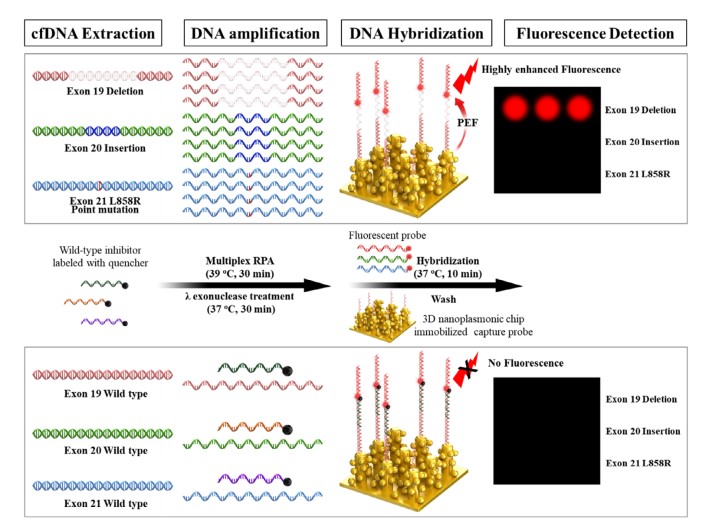
Scheme of the 3D-nanoplasmonic-based epidermal growth factor receptor (EGFR) mutation multiplex assay chip.
Superior Analytical Sensitivity and Specificity
In head-to-head comparisons with NGS, the 3D-nanoplasmonic-based assay demonstrated vastly superior sensitivity, detecting mutations at a frequency of 1 × 10⁻⁹%, a level unmatched by any existing method. The assay was able to accurately identify mutations even in samples with high concentrations of wild-type DNA, thanks to its enhanced fluorescence capabilities and the strategic use of wild-type inhibitors.
Clinical Validation and Performance
Clinical testing of the chip involved plasma samples from patients with malignant and benign lung tumors, as well as healthy individuals. The results were striking: the assay achieved 100% clinical sensitivity and specificity, correctly identifying all cases of malignant lung tumors, including those in early stages where traditional NGS failed. This level of accuracy highlights the chip’s potential to detect cancer at the earliest possible stage, when treatment is most effective.
Comparative Advantages Over Existing Technologies
NGS and Real-Time PCR Limitations: NGS and PCR methods often fail to detect low-frequency mutations, especially in early-stage cancer patients. They are also costly, time-consuming, and require complex equipment and expert interpretation.
Enhanced Sensitivity: The 3D-nanoplasmonic chip detects mutations at frequencies as low as 1 × 10⁻⁹%, outperforming digital PCR and other state-of-the-art methods by orders of magnitude. This sensitivity allows for the detection of rare mutations that might otherwise be missed.
Multiplex Capability: Unlike other assays that may require separate tests for each mutation, this chip can simultaneously detect multiple mutations, making it a powerful tool for comprehensive cancer screening.
Cost-Effectiveness and Speed: The assay’s low-cost design and rapid processing time make it suitable for widespread use, particularly in resource-limited settings where traditional methods may not be feasible.
Implications for Cancer Diagnosis and Treatment
The 3D-nanoplasmonic-based assay chip represents a paradigm shift in cancer diagnostics. By providing an economical, highly sensitive, and rapid method for detecting critical cancer mutations, this technology has the potential to revolutionize early cancer detection, improve patient monitoring, and personalize treatment strategies. Its high sensitivity ensures that even the smallest traces of cancer-related mutations are detected, allowing for timely and targeted therapeutic interventions.
Conclusion
The development of the 3D-nanoplasmonic-based multiplex assay chip marks a significant advancement in cancer detection technology. Its ultra-high sensitivity, combined with rapid and cost-effective processing, positions it as a groundbreaking tool for early cancer diagnosis and monitoring. By facilitating the accurate detection of EGFR mutations at ultra-low frequencies, this technology promises to improve patient outcomes through earlier intervention and more precise treatment decisions, paving the way for a new era in cancer care.
More information:
Ji Young Lee, Byeong-Ho Jeong, Ho Sang Jung, Taejoon Kang, Yeonkyung Park, Jin Kyung Rho, Sung-Gyu Park, and Min-Young Lee. "Highly Sensitive 3D‐Nanoplasmonic‐Based Epidermal Growth Factor Receptor Mutation Multiplex Assay Chip for Liquid Biopsy." Small Science 4 (2024): 2400101. DOI: 10.1002/smsc.202400101.








 English (United States) ·