
Controlling the direction of wave propagation, particularly achieving unidirectional travel, is a fundamental challenge with vast technological implications, including advancements in telecommunications, sound isolation, and electromagnetic wave applications. Traditional methods of achieving non-reciprocal wave transmission—where waves propagate preferentially in one direction—often face significant limitations, such as unavoidable losses due to the passive nature of these systems. A recent study by Tiemo Pedergnana, Abel Faure-Beaulieu, Romain Fleury, and Nicolas Noiray introduces a novel approach that not only enables sound waves to travel in a single direction but also compensates for transmission losses, marking a significant advancement in wave technology.
The Problem of Wave Reciprocity
Reciprocity in wave propagation means that waves travel symmetrically between a sender and receiver, posing challenges for applications requiring unidirectional transmission. Breaking this reciprocity is essential in scenarios such as protecting sensitive equipment from feedback, enhancing the performance of communication devices, and creating systems that are resilient to environmental imperfections. Existing methods, such as using resonant cavities biased by magneto-optical effects or external flows, typically suffer from significant dissipation losses, limiting their effectiveness and practical application.
Innovative Solution: Synchronization-Based Non-Reciprocal Transmission
The research team has developed a new method for breaking wave reciprocity using a synchronization-based approach that compensates for transmission losses. This technique exploits the interaction between incoming waves and self-sustained oscillations within a resonant cavity, known as limit cycles. Unlike traditional systems that passively absorb energy, this novel approach actively synchronizes the incident wave with the cavity’s oscillations, using the energy of the oscillations to amplify the incoming wave and compensate for losses.
How It Works: Synchronization and Loss Compensation
Non-Linear Interference: The heart of this technology is a resonant cavity configured to support self-sustained oscillations. When an incoming wave interacts with the cavity, it synchronizes with the oscillations, drawing energy from the cavity’s limit cycle to amplify itself. This process compensates for the inherent dissipation losses that typically occur in resonant systems.
Three-Port Circulator Design: The researchers constructed a three-port circulator with a unique configuration that exploits synchronization to achieve non-reciprocal transmission. This setup does not rely on internal active components to control wave propagation, making it fundamentally different from traditional designs that use electronic or magnetic biasing. Instead, the circulator uses non-linear gain from the cavity’s limit cycle to facilitate unidirectional wave travel while compensating for losses.
Compensation of Dissipation Losses: By converting the cavity resonance into a dynamic limit cycle, the system not only enhances non-reciprocal transmission but also effectively cancels out the energy lost to dissipation. This is achieved through the synchronized amplification of the incoming wave, a feature that sets this technology apart from conventional non-reciprocal devices, which often suffer from significant power loss.
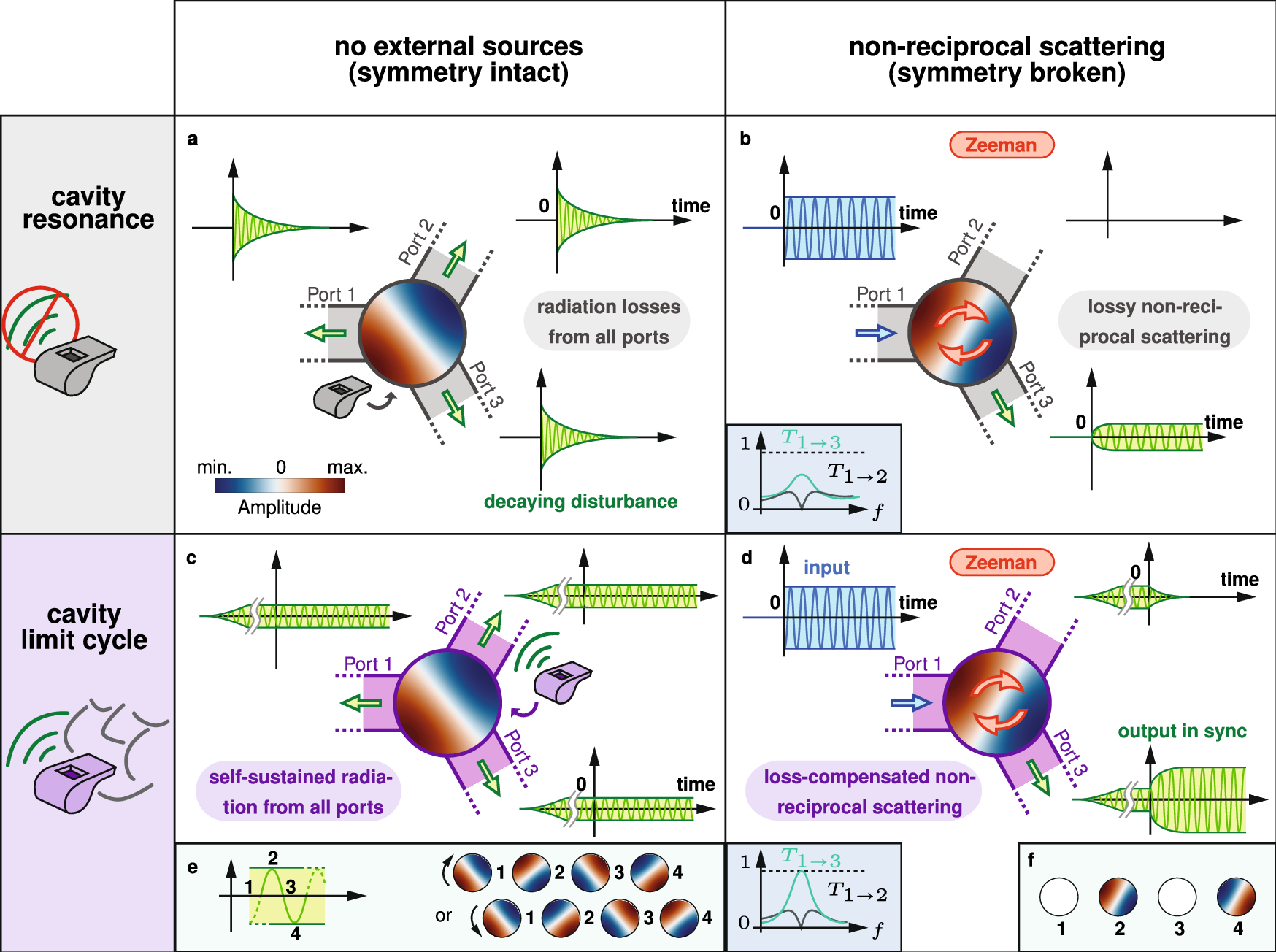
Concept of synchronization-based loss-compensated non-reciprocal scattering in a circulator.
Experimental Validation: Proof of Concept in Sound Transmission
The team demonstrated the practicality of their concept through acoustic scattering experiments using a custom-built circulator with a swirling flow inside a deep annular cavity. The setup included three ports positioned equidistantly along the cavity, which allowed the researchers to observe the behavior of sound waves under the synchronization-based mechanism. The circulator enabled unidirectional sound transmission with full immunity against losses, validating the theoretical predictions. Strong incident waves synchronized with the cavity’s self-sustained oscillations, effectively utilizing the cavity’s energy to enhance the wave’s transmission while blocking sound in the opposite direction.
Implications for Electromagnetic and Acoustic Wave Technologies
This breakthrough in sound wave manipulation has far-reaching implications for other forms of wave propagation, including electromagnetic waves used in communication systems. The synchronization-based approach can be adapted to create advanced devices such as electromagnetic circulators and isolators, which could dramatically improve signal integrity by preventing interference and feedback. These devices would benefit fields like telecommunications, radar, and photonics, where control over wave directionality and loss management are critical.
Future Directions and Potential Applications
The study opens the door to further exploration of non-reciprocal wave technologies across various physical platforms, including electronic and optical systems. By demonstrating the synchronization-based mechanism’s ability to overcome traditional constraints, the research suggests that similar principles could be applied to design high-frequency electromagnetic devices, optical networks, and even topological systems with enhanced robustness against defects. Future developments may include expanding this approach to multi-port systems, periodic lattices, and other complex arrangements that could leverage synchronization for improved performance.
Conclusion
The researchers’ innovative synchronization-based approach to non-reciprocal wave transmission represents a major advancement in the control of wave propagation. By effectively compensating for dissipation losses, this technology allows sound waves to travel unidirectionally with unprecedented efficiency, setting a new standard for wave manipulation in both acoustic and electromagnetic domains. This advancement promises to revolutionize how we design devices for telecommunications, acoustic control, and electromagnetic wave applications, pushing the boundaries of what is possible in wave-based technologies.
Reference
Pedergnana, T., Faure-Beaulieu, A., Fleury, R., & Noiray, N. "Loss-compensated non-reciprocal scattering based on synchronization." Nature Communications, 15, 7436 (2024). DOI: 10.1038/s41467-024-51373-y.








 English (United States) ·