
The frame-dragging effect, a phenomenon predicted by General Relativity, describes how a rotating object can twist the surrounding spacetime, causing local inertial frames to exhibit rotational frequency relative to infinity. This study explores the quantum effects of frame-dragging by investigating the excitation rates of atoms undergoing uniform circular motion in a curved spacetime environment. We propose a novel detection scheme to measure the frame-dragging frequency caused by rotating celestial bodies, leveraging quantum field theory without the need for traditional starlight calibration methods.
Since the formulation of General Relativity (GR), verifying its predictions has been a crucial scientific endeavor. One of its lesser-known phenomena is the frame-dragging effect, experimentally explored by missions such as Gravity Probe B. This satellite, launched by NASA, aimed to detect the precession of a gyroscope in curved spacetime. The frame-dragging effect suggests that local inertial frames around a rotating object rotate relative to the universe. However, traditional methods of measuring this effect rely on starlight calibration, which has inherent limitations, such as obstruction by the Earth or the drift of reference stars.
Inspired by the quantum field theory (QFT) in curved spacetime, this study seeks to measure the frame-dragging frequency using quantum effects. We show that the excitation rates of atoms in such environments are influenced by spacetime curvature, revealing a potential new method for detecting frame-dragging without relying on starlight.
Quantization of Scalar Fields in the Spacetime of a Rotating Sphere
To explore this, we begin by quantizing a massless scalar field in the spacetime around a rotating sphere. For a slowly rotating isotropic sphere, the spacetime metric can be expressed in terms of the frame-dragging frequency, which approximates the effects of gravitational interactions similar to a Kerr metric for rotating bodies.
In our framework, we solve the scalar field equation, taking into account weak field conditions and ensuring that the internal structure of the sphere does not significantly affect our calculations. This makes the analysis broadly applicable to various celestial bodies. The quantized scalar field, under these approximations, interacts indirectly with the rotating sphere through the curved spacetime background, rather than directly with the sphere itself.
Interaction Between Scalar Field and Atom
The Unruh-DeWitt detector model provides a foundation for understanding the excitation of an atom in a curved spacetime. This model involves a two-level atom interacting with a scalar field. The probability of the atom transitioning from its ground state to an excited state depends on its trajectory in spacetime. When the atom is at rest, there is no excitation due to the lack of mode mixing in the field operators.
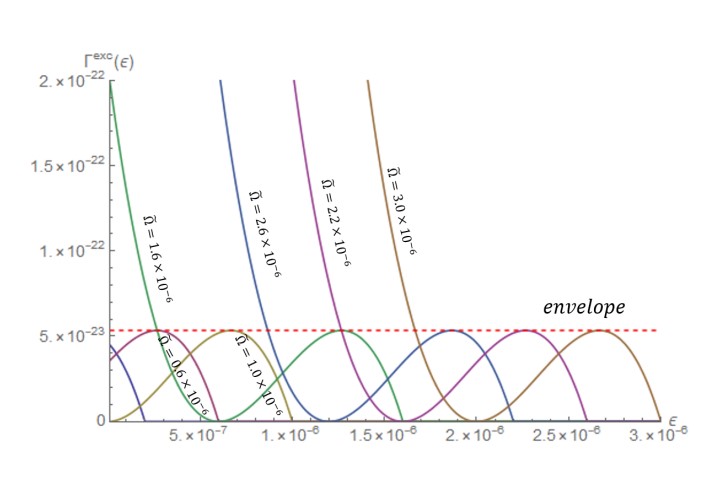
However, when an atom undergoes uniform circular motion near a rotating sphere, a different situation arises. The atom's trajectory in this locally dragged reference frame allows it to resonate with the positive frequency modes of the field. The excitation rate of the atom forms an envelope when plotted against different rotational frequencies, revealing a characteristic that correlates with the frame-dragging frequency.
The Quantum Detector of Frame-Dragging Effect
Based on these observations, we propose a detection scheme that utilizes a quantum detector to measure the frame-dragging effect. The detector consists of a rotating ring structure containing a large number of atoms undergoing uniform circular motion. Instead of relying on a single atom, which would result in a minimal excitation rate, we utilize a large number of atoms to enhance the detection efficiency through coherent enhancement, similar to the Dicke model.
The collective behavior of these atoms allows for a measurable excitation rate, forming an envelope from which the frame-dragging frequency can be extracted. The method is significantly more efficient than traditional measurements, as it does not rely on starlight calibration. The non-local properties of QFT enable direct measurement of the frame-dragging effect through the quantum interactions between atoms and the scalar field.
Conclusion
Our study provides a new quantum-based approach to detect the frame-dragging effect, moving beyond the classical methods that require starlight calibration. By analyzing the quantum excitation rates of atoms in a curved spacetime influenced by a rotating body, we demonstrate that the frame-dragging frequency can be effectively measured. This novel approach offers a deeper understanding of gravitational interactions at the quantum level and opens new possibilities for testing the predictions of General Relativity in various astrophysical contexts.
This article summarizes and expands on the findings presented in the paper, "The Frame-Dragging effect on the excitation rate of atoms," emphasizing the potential applications and significance of quantum detection methods in gravitational physics.
Source: https://arxiv.org/pdf/2408.13016









 English (United States) ·