
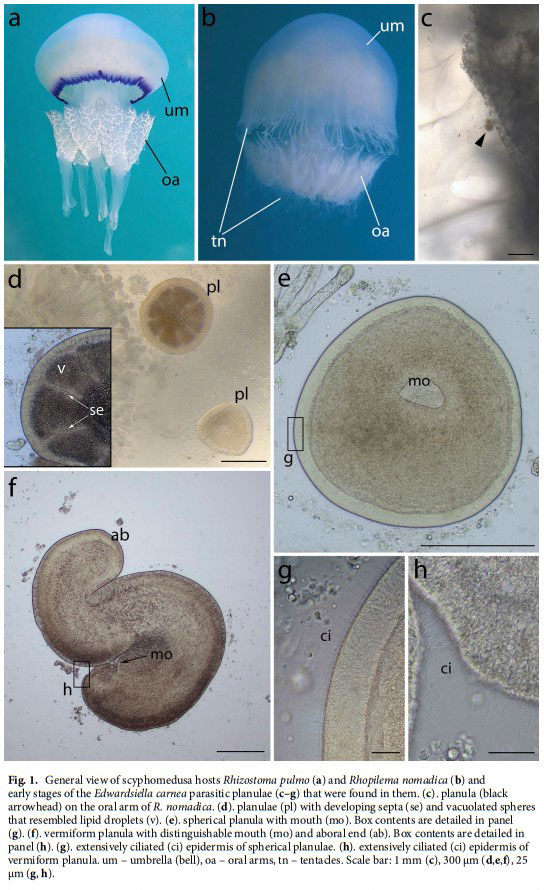
The complex and often hidden world of marine parasitism is gaining attention as scientists uncover new host-parasite dynamics. One particularly intriguing discovery involves the burrowing sea anemone Edwardsiella carnea, which has been found parasitizing not only its traditional host, the invasive ctenophore Mnemiopsis leidyi, but also two jellyfish species in the Eastern Mediterranean: the native barrel jellyfish Rhizostoma pulmo and the invasive nomad jellyfish Rhopilema nomadica. This unexpected host switch, termed “parasitic spillover,” highlights the ecological complexities and potential impacts of parasitism on native and invasive jellyfish populations.
Host-Parasite Dynamics: A Rare Host Switch
Most host-parasite associations are governed by evolutionary conservatism, meaning parasites typically infect hosts with which they have a long evolutionary history. Parasitic spillover, where parasites jump to new, unrelated hosts, is relatively rare and can have significant ecological consequences. In this study, researchers observed Edwardsiella carnea planulae parasitizing the jellyfish R. pulmo and R. nomadica, representing a novel host switch from the ctenophore M. leidyi. The parasitic planulae were found on the tentacles, oral arms, and even inside the gastrovascular canals of the scyphozoan jellyfish, suggesting a non-specific parasitic relationship that might be driven by changes in host availability rather than evolutionary adaptations.
Morphology and Life Cycle of Edwardsiella carnea
Edwardsiella carnea, a member of the family Edwardsiidae, typically has a restricted dispersal ability due to its short-lived planula stage, which only lasts a few days to two months. This limitation is partly overcome by parasitizing pelagic hosts like ctenophores, allowing the anemone to hitch a ride and disperse further than its free-swimming larvae would allow.
The life cycle of E. carnea begins with gametes released by polyps into the water column, where fertilization occurs. The resulting planula larvae are free-swimming but pre-parasitic, seeking out a suitable host to infect. In their ctenophore hosts, the planulae burrow into the epidermis or gastrodermal wall, eventually developing into a vermiform parasitic stage within the host’s mesoglea. This parasitic stage can remodel into a post-parasitic planula, which can leave the host and either re-infect another host or settle on the seafloor to develop into a polyp.
Molecular Identification and Spread
Using molecular analyses of the 16S and 18S rRNA genes, the researchers confirmed the identity of the planulae found in the jellyfish as belonging to Edwardsiella carnea. DNA metabarcoding further revealed the seasonal presence of Edwardsiella in the Eastern Mediterranean mesozooplankton, coinciding with the jellyfish blooms. This timing suggests that the parasitic spillover could be driven by the abundance of jellyfish during certain seasons, providing new hosts for E. carnea as ctenophore populations fluctuate.
Ecological Implications of the Spillover
The parasitic spillover of Edwardsiella carnea raises several ecological concerns, particularly regarding its impact on jellyfish populations. Parasitism can affect host organisms in numerous ways, including reduced growth, altered behavior, and decreased reproductive success. For instance, previous studies have shown that parasitized hosts often exhibit stunted growth and impaired reproductive output, which can have cascading effects on population dynamics.
In the Eastern Mediterranean, R. nomadica and R. pulmo are significant components of the marine ecosystem, with R. nomadica being a notorious invasive species. The parasitism by E. carnea might play a role in controlling the populations of these jellyfish, potentially offering a natural mechanism to manage invasive species. However, the overall impact on native species like R. pulmo is less clear and warrants further investigation.
Potential Drivers of Parasitic Spillover
The study suggests that the spillover of Edwardsiella carnea from ctenophores to jellyfish might be influenced by changes in host availability, particularly as jellyfish blooms become more prevalent in the region. This shift could be attributed to various factors, including climate change, which alters the distribution and abundance of marine species. As jellyfish become more abundant, they may provide an increasingly viable host option for E. carnea, facilitating the spillover event observed.
Additionally, the non-specific nature of the parasitism indicates that E. carnea does not rely on a particular host but instead targets available gelatinous hosts that can provide a suitable environment for its development. This adaptability might be key to the anemone’s survival in changing ecosystems, allowing it to exploit new opportunities as they arise.

Life cycle of a burrowing sea anemone Edwardsiella carnea. a. adult female and male polyps release gametes to the water column. b. a free-swimming pre-parasitic planula is formed following fertilization. c. the planula infects the ctenophore host Mnemiopsis leidyi and develops into vermiform parasitic stage. d. a post-parasitic planula leaves the ctenophore host into the water column (e) where it can either settle in the seabed (f) and develop into a polyp (a) or reinfect another ctenophore or infect schyphozoan host Rhopilema nomadica or Rhizostoma pulmo (hypothetical spillover) (g-h). a post-parasitic planula may leave the schyphozoan host, traveling in the water column (i) where it can settle on the seabed (f) and develop into a polyp. The dashed line represents an alternate pathway. Credit: Scientific Reports (2024). DOI: 10.1038/s41598-024-72168-7
Impact on Marine Biodiversity and Future Research Directions
The discovery of Edwardsiella carnea parasitizing jellyfish underscores the complex interactions that can occur between invasive species and native marine life. While the parasitism of invasive species like R. nomadica could potentially help control their populations, the effects on native species and broader ecosystem dynamics are less predictable. Parasites can alter host behavior, fitness, and survival, potentially influencing the structure of marine communities in significant ways.
Further research is needed to assess the full extent of E. carnea’s parasitic reach, including its potential impact on jellyfish growth, reproduction, and overall population health. Laboratory experiments that simulate natural conditions could provide valuable insights into how the parasite affects its hosts and how these effects might scale up to influence broader ecological patterns.
Moreover, understanding the conditions that promote parasitic spillover events, such as environmental stressors or shifts in host availability, could help predict future outbreaks and inform management strategies. As marine environments continue to change, monitoring these parasitic interactions will be crucial for predicting their ecological consequences and mitigating potential impacts on native biodiversity.
Conclusion
The first evidence of parasitic spillover of the burrowing sea anemone Edwardsiella carnea to jellyfish hosts in the Eastern Mediterranean highlights the dynamic nature of marine parasitism and its potential ecological implications. This novel host switch from ctenophores to jellyfish suggests that parasitism in marine ecosystems may be more fluid and responsive to environmental changes than previously thought. As the Mediterranean continues to experience shifts in species distributions and abundances, understanding these parasitic relationships will be key to managing the impacts of invasive species and preserving native marine biodiversity.
More information: Anastasiia Iakovleva et al, From ctenophores to scyphozoans: parasitic spillover of a burrowing sea anemone, Scientific Reports (2024). DOI: 10.1038/s41598-024-72168-7







 English (United States) ·