
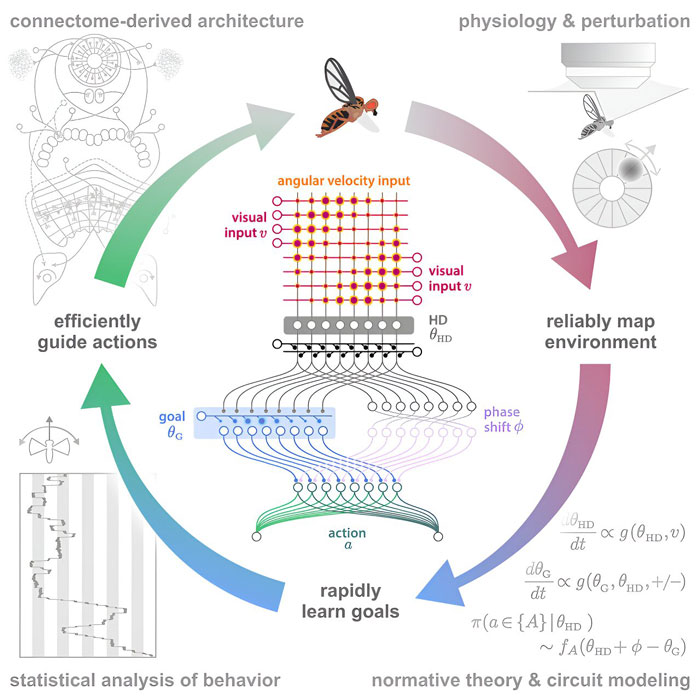
The study of goal-directed navigation in animals, particularly in novel environments, reveals how internal representations of spatial orientation and goal locations are used to guide behavior. In fruit flies (Drosophila melanogaster), these representations are crucial for learning and adapting in response to environmental changes. The research by Dan et al. (2024) explores how fruit flies use internal head direction (HD) cells to navigate and achieve specific goals, demonstrating the co-evolution of HD and goal representations within structured but flexible neural circuits.
Head Direction Cells and Navigation
Head Direction (HD) cells are specialized neurons that encode an animal’s orientation relative to its environment. In fruit flies, these cells are located within the central complex (CX) of the brain, particularly in regions like the ellipsoid body (EB) and protocerebral bridge (PB). These neurons create an internal compass that allows flies to maintain and adjust their heading based on learned experiences and sensory inputs.
Learning in Novel Environments
Navigating in novel environments requires the simultaneous development of spatial maps and goal representations. The study reveals that fruit flies achieve this through a structured learning process involving HD cells. Initially, the flies use stochastic fixations and saccades (rapid head or body movements) to explore their surroundings. These movements are modified over time based on feedback, such as thermal punishment, which helps the flies learn to associate certain orientations with safety or danger.
The Role of the Central Complex (CX)
The CX, particularly the EB and PB, plays a critical role in processing spatial information and guiding goal-directed behavior. The study shows that HD neurons within the EB form a localized activity "bump" that rotates with the fly’s movements, creating a dynamic internal representation of direction. This bump is influenced by visual inputs from ring neurons, which are tuned to specific spatial features and inhibit HD neurons in a pattern that stabilizes the fly’s internal compass.
Interaction of Head Direction and Goal Representations
The study highlights the co-evolution of HD and goal representations during learning. HD cells provide a stable framework that allows flies to anchor goal representations, which are adjusted based on experiences of punishment or reward. This interaction supports rapid learning and adaptation, enabling the fly to quickly modify its behavior when navigating toward a goal.
Behavioral Policies and Circuit Architecture
Fruit flies rely on a fixed-form behavioral policy that uses the difference between HD and goal headings to guide actions. This policy is encoded in the neural architecture of the CX and is modulated by reinforcement signals. The fly’s behavior is structured around a preferred goal heading, which drives actions such as fixations and saccades toward the goal. The neural circuits are hardwired to perform specific computations, like phase shifts in HD neuron activity, that facilitate this policy.
Implications for Variability in Learning
Individual variability in learning performance is shaped by the stability of HD and goal representations. The study finds that flies with more stable HD representations are better at maintaining consistent goal-directed behavior, while those with less stable representations show greater variability in learning outcomes. This suggests that the interplay between HD stability and goal representation strength is a key determinant of individual differences in navigation skills.
Conclusion
The research by Dan et al. (2024) provides a detailed look at how fruit flies use internal representations of head direction to navigate toward goals in novel environments. By integrating HD and goal representations within a structured but flexible neural circuit, fruit flies achieve rapid and adaptive learning. This study not only advances our understanding of insect navigation but also offers insights into the general principles of goal-directed behavior in animals, highlighting the importance of stable internal representations in guiding complex behaviors.
This summary captures the key findings and mechanisms from the study, focusing on the role of head direction cells and their interaction with goal representations in supporting navigation in fruit flies.
More information: Chuntao Dan et al, A neural circuit architecture for rapid learning in goal-directed navigation, Neuron (2024). DOI: 10.1016/j.neuron.2024.04.036






 English (United States) ·